
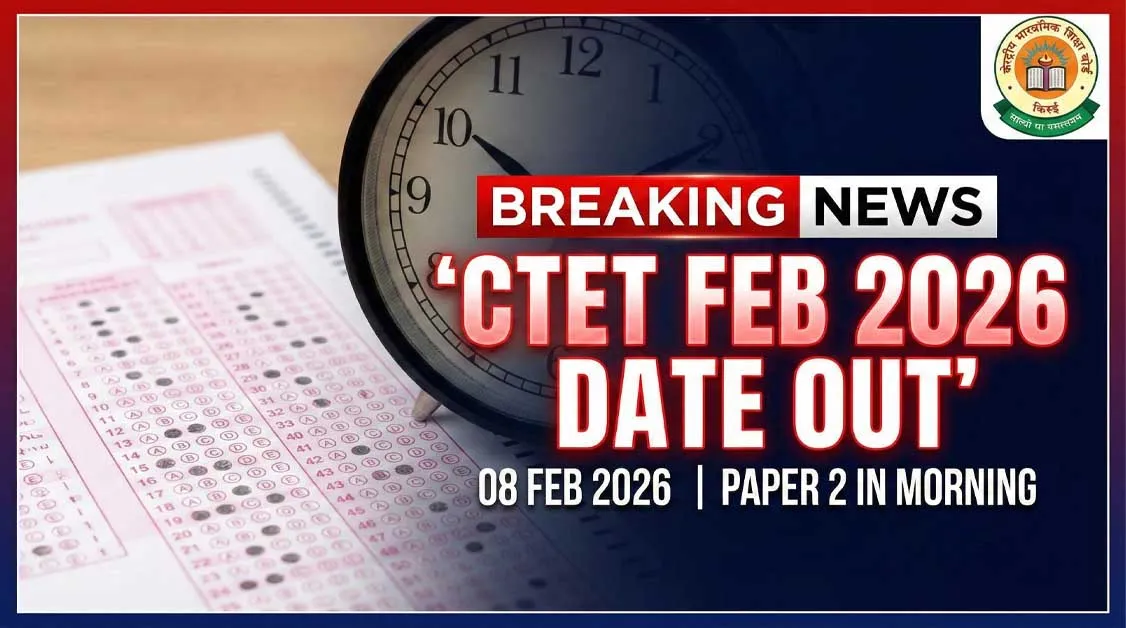
The Central Board of Secondary Education (CBSE) has officially confirmed the schedule for the Central Teacher Eligibility Test (CTET Exam) February 2026. In a significant update for the 2026 cycle, the exam will be conducted on Sunday, February 8, 2026, with a major revision in the shift timings for Paper I and Paper II.
While the application window successfully closed on December 18, 2025, candidates must now focus on the revised schedule. Unlike previous years where Paper I (Primary) was often in the morning, Paper II (Elementary) will now be conducted in the Morning Shift, and Paper I will be held in the Evening Shift.
Urgent Update: The CTET February 2026 exam will be held on 08-02-2026. Candidates must reach the center by 07:30 AM for Shift 1 and 12:30 PM for Shift 2.
CTET Exam 2026 Highlights
The 2026 edition of CTET comes with specific guidelines regarding entry times and result declaration. Here is the official summary:
| Feature | Details |
| Exam Name | Central Teacher Eligibility Test (CTET) |
| Conducting Body | Central Board of Secondary Education (CBSE) |
| Exam Date | 08 February 2026 (Sunday) |
| Application Dates | 27.11.2025 to 18.12.2025 (Closed) |
| Result Declaration | End of March 2026 (Tentatively) |
| Official Website | ctet.nic.in |
CTET Exam Dates 2026 (Official Schedule)
The following schedule is final as per the Information Bulletin. Candidates must strictly adhere to the entry timings to avoid disqualification.
| Event | Date / Time |
| CTET Exam Date | 08 February 2026 |
| Admit Card Release | 2 Days Before Exam (Expected Feb 5-6) |
| Entry in Exam Centre (Shift 1) | 07:30 AM |
| Entry in Exam Centre (Shift 2) | 12:30 PM |
| Gate Closure | 09:30 AM (Shift 1) / 02:30 PM (Shift 2) |
CTET 2026 Eligibility Criteria
Nationality Criteria
To be eligible for CTET 2026, a candidate must fall into one of the following categories:
- A citizen of India.
- A subject of Nepal.
- A subject of Bhutan.
- A Tibetan refugee who came to India before January 1, 1962, with the intention of permanently settling in India.
- A person of Indian origin who has migrated from Pakistan, Sri Lanka, Myanmar (Burma), East African countries (Kenya, Uganda, the United Republic of Tanzania, Zambia, Malawi, Zaire, Ethiopia), or Vietnam with the intention of permanently settling in India.
Educational Qualifications
The minimum qualifications are categorized by the level of teaching (Paper I or Paper II).
Paper I (For Classes 1 to 5 – Primary Stage)
Candidates must fulfill any one of the following criteria:
- Senior Secondary (or equivalent) with at least 50% marks and passed or appearing in the final year of a 2-year Diploma in Elementary Education (D.El.Ed).
- Senior Secondary (or equivalent) with at least 45% marks and passed or appearing in the final year of a 2-year Diploma in Elementary Education (D.El.Ed), in accordance with the NCTE (Recognition Norms and Procedure) Regulations, 2002.
- Senior Secondary (or equivalent) with at least 50% marks and passed or appearing in the final year of a 4-year Bachelor of Elementary Education (B.El.Ed).
- Senior Secondary (or equivalent) with at least 50% marks and passed or appearing in the final year of a 2-year Diploma in Education (Special Education).
- Graduation with at least 50% marks and passed or appearing in the final year of a Bachelor of Education (B.Ed).
Paper II (For Classes 6 to 8 – Elementary Stage)
Candidates must fulfill any one of the following criteria:
- Graduation and passed or appearing in the final year of a 2-year Diploma in Elementary Education (D.El.Ed).
- Graduation with at least 50% marks and passed or appearing in the final year of a Bachelor in Education (B.Ed).
- Graduation with at least 45% marks and passed or appearing in the final year of a Bachelor in Education (B.Ed), in accordance with the NCTE (Recognition Norms and Procedure) Regulations.
- Senior Secondary (or equivalent) with at least 50% marks and passed or appearing in the final year of a 4-year Bachelor in Elementary Education (B.El.Ed).
- Senior Secondary (or equivalent) with at least 50% marks and passed or appearing in the final year of a 4-year B.A./B.Sc.Ed or B.A.Ed/B.Sc.Ed.
- Graduation with at least 50% marks and passed or appearing in the final year of B.Ed. (Special Education) .
Age Limit
- Minimum Age: The minimum age to apply for CTET is 18 years.
- Maximum Age: There is no upper age limit for taking the exam.
Relaxations & Reservations
- Qualifying Marks Relaxation: A relaxation of 5% in the qualifying marks for the minimum educational qualification is allowed for candidates belonging to reserved categories, such as SC, ST, OBC, and Differently-abled.
- Physical Limitations: Candidates with benchmark disabilities (blindness, locomotor disability, cerebral palsy, etc.) are eligible for the facility of a Scribe/Reader/Lab Assistant and compensatory time of 50 minutes per paper.
Important Note on Eligibility Verification
Permission to appear in the CTET does not imply that a candidate’s eligibility has been verified. Final verification of eligibility is conducted by the concerned recruiting agency or appointing authority at the time of appointment. It is the candidate’s responsibility to ensure they meet the criteria before applying.
CTET 2026 Application Process
The online application process for this cycle was active from November 27, 2025, to December 18, 2025. Candidates who successfully submitted their forms and fees before the deadline are now eligible to appear for the exam. The correction window has also closed.
Important Dates
The following timeline governs the CTET February 2026 cycle:
| Event | Date |
| Application Start Date | November 27, 2025 |
| Last Date to Apply | December 18, 2025 (Initial Deadline) |
| Fee Payment Deadline | December 18, 2025 (Before 11:59 PM) |
| Correction Window | December 23, 2025 – December 26, 2025 |
| Exam Date | February 8, 2026 (Sunday) |
Application Fee Structure
The application fee varies based on the candidate’s category and the number of papers selected.
| Category | Only Paper I or II | Both Paper I & II |
| General / OBC (NCL) | ₹ 1,000/- | ₹ 1,200/- |
| SC / ST / Differently Abled | ₹ 500/- | ₹ 600/- |
| Note: GST is charged extra by the bank. |
Prerequisites: Documents & Image Specifications
Before starting the application, candidates must have the following scanned documents ready in JPG/JPEG format.
- Photograph:
- Size: 10 to 100 KB.
- Dimensions: 3.5 cm (width) x 4.5 cm (height).
- Requirement: Recent photograph.
- Signature:
- Size: 3 to 30 KB.
- Dimensions: 3.5 cm (length) x 1.5 cm (height).
- Other Requirements:
- A valid email ID and mobile number for OTP and communication.
- Class X certificate for date of birth verification.
Step-by-Step Application Process
Candidates must apply online through the official website https://ctet.nic.in. There is no offline mode for submission.
Step 1: Registration
- Visit the official CTET website and click on “Apply Online”.
- Fill in the Authentication Form with details like State, Identification Type (e.g., Aadhaar, Passport), Candidate’s Name, Date of Birth, and Gender.
- Create a password (8-13 characters, with at least one uppercase, one lowercase, one numeric, and one special character).
- Submit to generate a Registration Number/Application Number.
Step 2: Fill the Application Form
Log in using the generated Registration Number and Password to complete the form.
- Personal Details: Enter Mother’s Name and Father’s Name as per Class X certificate.
- Apply For: Select Paper I (Classes 1-5), Paper II (Classes 6-8), or Both.
- Languages: Choose two different languages (Language I and Language II).
- Exam Centre: Provide four different options for exam cities in order of preference.
- Education: Enter details of the qualifying degree/diploma (Status, Year, Stream, Board/University).
Step 3: Upload Scanned Images
Upload the photograph and signature in the specified JPG/JPEG format and dimensions mentioned in the “Prerequisites” section above.
Step 4: Pay Examination Fee
Payment can be made via Debit Card, Credit Card, or Net Banking.
- If the fee status is not “OK” immediately, verify if the transaction was cancelled; refunded amounts usually return within a week.
Step 5: Print Confirmation Page
After successful payment, a Confirmation Page is generated. Candidates must print and retain this page for future reference. Do not send the hard copy to the CTET Unit.
Important Correction & Validity Info
- Correction Window: A one-time facility to correct particulars (except the city of examination) is provided online (Dec 23–26, 2025).
- Certificate Validity: The CTET qualifying certificate is valid for a lifetime.
- Qualifying Marks: Candidates need to score 60% or more to pass. (55% for reserved categories like SC/ST/OBC/Differently Abled) .
CTET Exam 2026 Admit Card
The Admit Card is expected to be released in two phases:
- City Intimation Slip: Likely by the last week of January 2026.
- Final Admit Card: Detailed hall tickets usually release 2 days before the exam. Candidates will need their Application Number and Date of Birth to download it from
ctet.nic.in.
CTET 2026 Exam Pattern & Shift Timings (REVISED)
Crucial Insight: CBSE has swapped the traditional timings. Paper II will now be held in the morning.
| Feature | Paper II (Elementary Stage) | Paper I (Primary Stage) |
| Exam Date | 08-02-2026 | 08-02-2026 |
| Shift | MORNING | EVENING |
| Time Duration | 09:30 AM to 12:00 Noon | 02:30 PM to 05:00 PM |
| Entry Time | 07:30 AM | 12:30 PM |
| Checking of Admit Cards | 09:00 AM to 09:15 AM | 02:00 PM to 02:15 PM |
CTET 2026 Syllabus
Based on the CTET Information Bulletin for February 2026, the syllabus is divided into two papers: Paper I (for teachers of Classes I–V) and Paper II (for teachers of Classes VI–VIII).
Paper I: Primary Stage (Classes I–V)
Duration: 2.5 Hours | Total MCQs: 150 | Total Marks: 150
1. Child Development and Pedagogy (30 Questions)
- Child Development (Primary School Child): Concepts of development, principles of child development, heredity & environment, socialization processes, Piaget, Kohlberg and Vygotsky, child-centered education, intelligence, and gender as a social construct.
- Concept of Inclusive Education & Children with Special Needs: Addressing learners from diverse backgrounds, learning difficulties, and talented/creative learners.
- Learning and Pedagogy: How children think and learn, basic teaching processes, child as a problem solver, cognition & emotions, and motivation.
2. Language I (Compulsory) (30 Questions)
- Language Comprehension: Reading unseen passages (prose/drama and poem) with questions on comprehension, inference, grammar, and verbal ability.
- Pedagogy of Language Development: Learning and acquisition, principles of teaching, role of listening/speaking, grammar, challenges in diverse classrooms, and remedial teaching.
3. Language II (Compulsory) (30 Questions)
- Comprehension: Two unseen prose passages (discursive, literary, narrative, or scientific) with questions on comprehension, grammar, and verbal ability.
- Pedagogy of Language Development: Similar to Language I, focusing on communication, comprehension, and language skills.
4. Mathematics (30 Questions)
- Content: Geometry, Shapes & Spatial Understanding, Solids around Us, Numbers, Addition, Subtraction, Multiplication, Division, Measurement, Weight, Time, Volume, Data Handling, Patterns, and Money.
- Pedagogical Issues: Nature of Mathematics, curriculum place, language of math, community math, evaluation, and diagnostic/remedial teaching.
5. Environmental Studies (EVS) (30 Questions)
- Content: Family and Friends (Relationships, Work and Play, Animals, Plants), Food, Shelter, Water, Travel, and Things We Make and Do.
- Pedagogical Issues: Concept and scope of EVS, learning principles, approaches to concepts, activities, experimentation, discussion, and CCE.
Paper II: Elementary Stage (Classes VI–VIII)
Duration: 2.5 Hours | Total MCQs: 150 | Total Marks: 150
1. Child Development and Pedagogy (30 Questions)
- Child Development (Elementary School Child): Similar to Paper I but relevant to the age group 11–14 years.
- Inclusive Education & Special Needs: Addressing disadvantaged learners and physical/learning difficulties.
- Learning and Pedagogy: Motivation, cognition, alternative conceptions of learning, and the child as a “scientific investigator”.
2. Language I & II (Compulsory) (30 Questions each)
- Syllabus: Same structure as Paper I (Comprehension + Pedagogy), but the difficulty standard may be up to the Senior Secondary stage.
3. Mathematics and Science (For Math/Science Teachers) (60 Questions)
- Mathematics (30 Questions):
- Content: Number System (Knowing our numbers, Whole numbers, Integers, Fractions), Algebra (Introduction, Ratio and Proportion), Geometry (2-D/3-D shapes, Symmetry, Construction), Mensuration, and Data Handling.
- Pedagogy: Nature of Math, curriculum, evaluation, and remedial teaching.
- Science (30 Questions):
- Content: Food (Sources, Components, Cleaning), Materials (Daily use), The World of the Living, Moving Things/People/Ideas, How things work (Electric current, circuits, Magnets), Natural Phenomena, and Natural Resources.
- Pedagogy: Aims & objectives, integrated approach, observation/experimentation, and innovation.
4. Social Studies/Social Sciences (For Social Studies Teachers) (60 Questions)
- History: From “When, Where and How” to “India After Independence,” including the First Cities, New Kings and Kingdoms, Sultans of Delhi, Architecture, Revolt of 1857, and the Nationalist Movement.
- Geography: Planet Earth, Globe, Environment (Air, Water), Human Environment (Settlement, Transport), Resources, and Agriculture.
- Social and Political Life: Diversity, Government (Local and State), Democracy, Understanding Media, The Constitution, Parliamentary Government, Judiciary, and Social Justice.
- Pedagogical Issues: Concept of Social Science, classroom processes, critical thinking, empirical evidence, and project work.
CTET 2026 Exam Centre
The CTET February 2026 examination will be conducted in the cities listed below. The following table provides the complete list of examination centers with their corresponding city codes and states, as released in the official notification.
CTET 2026 Exam Center List
| City Code | State | City |
| 101 | Andaman & Nicobar | Port Blair |
| 102 | Andhra Pradesh | Guntur |
| 103 | Andhra Pradesh | Tirupati |
| 104 | Andhra Pradesh | Vijayawada |
| 105 | Andhra Pradesh | Visakhapatnam |
| 106 | Arunachal Pradesh | Itanagar |
| 107 | Assam | Dibrugarh |
| 108 | Assam | Guwahati |
| 109 | Assam | Silchar |
| 110 | Bihar | Begusarai |
| 111 | Bihar | Bhagalpur |
| 112 | Bihar | Bhojpur (Ara) |
| 113 | Bihar | Darbhanga |
| 114 | Bihar | Gaya |
| 115 | Bihar | Gopalganj |
| 116 | Bihar | Madhubani |
| 117 | Bihar | Muzaffarpur |
| 118 | Bihar | Nalanda |
| 119 | Bihar | Patna |
| 120 | Bihar | Purnia |
| 121 | Bihar | Rohtas |
| 122 | Bihar | Saharsa |
| 123 | Bihar | Samastipur |
| 124 | Bihar | Saran |
| 125 | Bihar | Vaishali (Hajipur) |
| 126 | Chandigarh | Chandigarh |
| 127 | Chhattisgarh | Bhilai/Durg |
| 128 | Chhattisgarh | Bilaspur |
| 129 | Chhattisgarh | Raipur |
| 130 | Dadra & Nagar Haveli | Dadra & Nagar Haveli |
| 131 | Daman & Diu | Daman |
| 132 | Delhi | Delhi |
| 137 | Goa | Panaji |
| 138 | Gujarat | Ahmedabad |
| 139 | Gujarat | Rajkot |
| 140 | Gujarat | Surat |
| 141 | Gujarat | Vadodara |
| 142 | Haryana | Ambala |
| 143 | Haryana | Faridabad |
| 144 | Haryana | Gurugram |
| 145 | Haryana | Hissar |
| 146 | Haryana | Karnal |
| 147 | Haryana | Kurukshetra |
| 148 | Himachal Pradesh | Hamirpur |
| 149 | Himachal Pradesh | Kangra |
| 150 | Himachal Pradesh | Shimla |
| 151 | Jammu & Kashmir | Jammu |
| 152 | Jammu & Kashmir | Srinagar |
| 153 | Jharkhand | Bokaro |
| 154 | Jharkhand | Dhanbad |
| 155 | Jharkhand | Hazaribagh |
| 156 | Jharkhand | Jamshedpur |
| 157 | Jharkhand | Ranchi |
| 158 | Karnataka | Bengaluru |
| 159 | Karnataka | Hubli |
| 160 | Kerala | Ernakulam |
| 161 | Kerala | Kozhikode |
| 162 | Kerala | Thiruvananthapuram |
| 163 | Ladakh | Kargil |
| 164 | Ladakh | Leh |
| 165 | Lakshadweep | Kavarati |
| 166 | Madhya Pradesh | Bhopal |
| 167 | Madhya Pradesh | Gwalior |
| 168 | Madhya Pradesh | Indore |
| 169 | Madhya Pradesh | Jabalpur |
| 170 | Maharashtra | Amravati |
| 171 | Maharashtra | Aurangabad |
| 172 | Maharashtra | Mumbai |
| 173 | Maharashtra | Nagpur |
| 174 | Maharashtra | Nashik |
| 175 | Maharashtra | Pune |
| 176 | Maharashtra | Solapur |
| 177 | Manipur | Imphal |
| 178 | Meghalaya | Shillong |
| 179 | Mizoram | Aizawl |
| 180 | Nagaland | Kohima |
| 181 | Odisha | Bhubaneswar |
| 182 | Odisha | Sambalpur |
| 183 | Puducherry | Puducherry |
| 184 | Punjab | Amritsar |
| 185 | Punjab | Bhatinda |
| 186 | Punjab | Jalandhar |
| 187 | Rajasthan | Ajmer |
| 188 | Rajasthan | Alwar |
| 189 | Rajasthan | Bikaner |
| 190 | Rajasthan | Jaipur |
| 191 | Rajasthan | Jodhpur |
| 192 | Rajasthan | Kota |
| 193 | Rajasthan | Udaipur |
| 194 | Sikkim | Gangtok |
| 195 | Tamil Nadu | Chennai |
| 196 | Tamil Nadu | Coimbatore |
| 197 | Tamil Nadu | Madurai |
| 198 | Telangana | Hyderabad |
| 199 | Telangana | Warangal |
| 200 | Tripura | Agartala |
| 201 | Uttar Pradesh | Agra |
| 202 | Uttar Pradesh | Aligarh |
| 203 | Uttar Pradesh | Ambedkar Nagar |
| 204 | Uttar Pradesh | Ayodhya (Faizabad) |
| 205 | Uttar Pradesh | Bareilly |
| 206 | Uttar Pradesh | Bijnor |
| 207 | Uttar Pradesh | Deoria |
| 208 | Uttar Pradesh | Etawah |
| 209 | Uttar Pradesh | Ghaziabad |
| 210 | Uttar Pradesh | Ghazipur |
| 211 | Uttar Pradesh | Gonda |
| 212 | Uttar Pradesh | Gorakhpur |
| 213 | Uttar Pradesh | Jaunpur |
| 214 | Uttar Pradesh | Jhansi |
| 215 | Uttar Pradesh | Kanpur |
| 216 | Uttar Pradesh | Lucknow |
| 217 | Uttar Pradesh | Mainpuri |
| 218 | Uttar Pradesh | Mathura |
| 219 | Uttar Pradesh | Mau |
| 220 | Uttar Pradesh | Meerut |
| 221 | Uttar Pradesh | Moradabad |
| 222 | Uttar Pradesh | Noida/Greater Noida |
| 223 | Uttar Pradesh | Pratapgarh |
| 224 | Uttar Pradesh | Prayagraj (Allahabad) |
| 225 | Uttar Pradesh | Raebareli |
| 226 | Uttar Pradesh | Saharanpur |
| 227 | Uttar Pradesh | Shahjahanpur |
| 228 | Uttar Pradesh | Sitapur |
| 229 | Uttar Pradesh | Sultanpur |
| 230 | Uttar Pradesh | Varanasi |
| 231 | Uttarakhand | Dehradun |
| 232 | Uttarakhand | Haldwani |
| 233 | Uttarakhand | Haridwar |
| 234 | Uttarakhand | Udham Singh Nagar |
| 235 | West Bengal | Kolkata |
| 236 | West Bengal | Siliguri |
CTET 2026 Answer Key
Based on the provided documents, here are the details regarding the CTET February 2026 Answer Key:
Release and Availability
- Official Display: The CBSE will display the scanned images of the OMR Answer Sheets and the Answer Keys on the official website (
https://ctet.nic.in). - Duration: The answer keys are likely to be available for a period of two to three days to allow candidates to review them.
- Public Notice: A public notice will be issued on the website to announce the availability of the keys.
How to Download the Answer Key
- Visit the official website:
https://ctet.nic.in. - Locate and click on the link for “Provisional Answer Key 2026”.
- Log in using your Roll Number and Date of Birth.
- Download the answer key and OMR sheet to check your responses.
Challenging the Answer Key
If you are not satisfied with any of the answers, you can submit a challenge online during the stipulated time.
- Fee: Rs. 1000/- per question. This is a processing charge and is generally non-refundable.
- Refund Policy: If your challenge is accepted by the subject experts (i.e., a mistake is found in the key), the fee will be refunded to the concerned candidate.
- Process: Challenges must be submitted online. Challenges sent via email, post, or in person will not be accepted.
- Final Decision: The decision of the Board on the challenges is final, and no further communication will be entertained. The final result will be declared according to the final answer keys prepared by experts.
Obtaining OMR Sheet Photocopy (Post-Result)
After the declaration of the result, candidates can seek a photocopy of their OMR Answer Sheet along with the calculation sheet by paying a fee of Rs. 500/- per OMR. This must be done via a Demand Draft in favor of the Secretary, Central Board of Secondary Education, payable at Delhi.
CTET 2026 Result
The official notification states that the Declaration of Result is tentatively scheduled for the end of MARCH 2026. The result will be hosted on the official website and DigiLocker.
CTET 2026 Cutoff Marks
- General Category: 60% (90 Marks).
- Reserved Categories: 55% (82 Marks).
- Note: Qualifying CTET is just an eligibility criterion; it does not confer a right to employment.
CTET Exam Previous Year Papers
Based on your uploaded documents and the official CTET website, here is the information regarding CTET Previous Year Papers:
Available Previous Year Papers
Your uploaded document lists the following years for which previous year papers are essential for practice:
- 2024
- 2023
- 2022
- 2021
The official CTET website’s archive also provides question papers for additional years, including December 2018, July 2019, December 2019, and January 2021.
How to Access the Papers
You can download the Question Papers and Answer Keys directly from the official CTET website archive.
- Official Website: Visit
https://ctet.nic.in. - Archive Section: Navigate to the “Archive” section to find links for previous years.
- Recent Papers: Papers from recent exams (e.g., January 2024, August 2023) are typically listed under the “Question Paper” tab or specific notifications.
Why You Should Solve Them
According to your preparation strategies document, solving previous year papers is critical for the following reasons:
- Understand the Exam Pattern: It helps you get an idea of the nature and standard of questions asked.
- Time Management: Practicing with these papers helps in managing time effectively during the actual exam.
- Identify Trends: It allows you to see which topics are frequently repeated or emphasized